How Does a Liquor Store POS Use Dual Pricing to Offset Processing Costs?

liquor store dual pricing POS

Walk into any liquor store on a Friday evening, and you’ll see the same story playing out at the register: a steady stream of card taps, chip insertions, and contactless payments. Cash is becoming the exception, not the rule. While this effortless experience is great for consumers, it creates a hidden cost for the liquor store owners, who have to pay a processing fee on every single one of those card taps.

For an industry that already runs on the narrowest of margins, credit card processing fees feel like a direct hit to the bottom line on every sale. The good news? A growing number of owners are taking control of these costs by adopting a liquor store dual pricing POS system. By showing both cash and card prices at checkout, this setup wipes out processing fees, protects your profits, and keeps pricing clear for customers.

In this guide, we’ll learn in detail about how it works, why it matters specifically for liquor store owners, and how the right liquor store POS system can simplify the entire payment process.

Why Credit Card Fees Hit Liquor Stores Harder?

On paper, running a liquor store looks easy. Inventory moves fast, and customers buy every day. But ask any store owner, and they’ll tell you margins are razor-thin. Between high taxes, license fees, and tough competition, there’s little room for extra costs. That’s why credit card processing fees hurt so much. Without a plan to offset those swipe fees, you’re giving away a huge chunk of your profit every year.

For liquor stores, these credit card fees sit in a uniquely painful spot. Here’s why:

High average ticket sizes:

Wine, spirits, and craft beer purchases are comparatively more expensive than a typical convenience store basket. Because interchange fees are calculated as a percentage of the transaction (usually 1.5%-3.5%), higher ticket prices mean more dollars lost per sale.

Small margins to start with:

Alcohol is tax-overwhelmed and tightly regulated. Between state excise laws, costly licensing fees, and aggressive pricing from retail chains, independent liquor store margins are squeezed from the beginning.

Card-heavy customer base:

Liquor purchases tend to peak during evenings and weekends, exactly when consumers are least likely to be using cash. This means more transactions are processed through alcohol retail payment systems, where processing fees apply.

Seasonal spikes:

Holidays, game days, and celebrations lead to sales rushes, and every one of those transactions comes with a fee attached. During the high season, that little 2-3% fee can add up to thousands of dollars in lower earnings.

In a few words, liquor retailers process more dollars per swipe, more commonly, on shorter margins than almost any other store category. This is the only reason why most retailers are seeking a way to counterbalance or avoid this cost completely.

What Exactly is a Liquor Store Dual Pricing POS System?

A dual pricing POS system is technology that allows a retailer to display and charge two different prices for the same item: one price for cash payments, and a slightly higher price for card payments. Instead of slapping customers with a frustrating surcharge at checkout, dual pricing twists the cost right into your standard cash discount setup. The price they see on the tag already covers the processing fee, making the whole experience feel seamless.

We’re not talking about a temporary fix or playing in a legal gray area. This is a fully compliant cash discount strategy that’s already big in the restaurant and gas station industries, and it’s now taking over liquor stores. Why? Because it simply shifts processing costs to the cards that generate them—all while keeping things completely transparent and fair for your cash-paying regulars.

How it Works at the Register

Here’s the simplified version of how dual pricing POS works in a real store:

  1. Every product carries two visible prices — a cash price and a slightly higher credit price (the difference typically mirrors the store’s processing cost, often 3–4%).
  2. When a customer checks out, the POS system automatically detects the payment method.
  3. If they pay with cash, they’re charged the lower price.
  4. If they pay with a credit or debit card, the system automatically applies the credit price — no manual math, no awkward conversations, no separate “convenience fee” line item.
  5. The receipt clearly reflects the applied pricing, keeping everything transparent and above board.

The whole process happens in seconds, and when powered by RetailZPOS, a well-designed liquor store point of sale software, it’s fully automated. The cashier doesn’t need to calculate anything or explain a surcharge.

Dual Pricing vs. Surcharging vs. Cash Discounting: Understanding the Differences

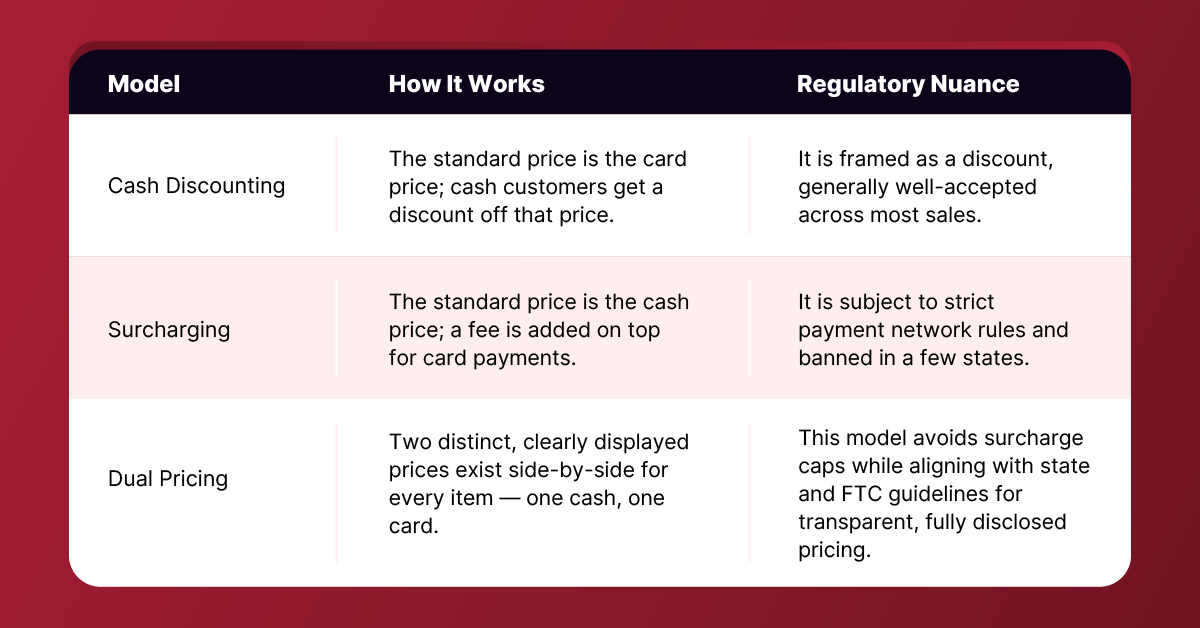
These three terms get thrown around interchangeably, but they are legally and practically different. Understanding this difference matters, specifically for legal dual pricing program adherence.
Dual Pricing

The crucial distinction between surcharging and dual pricing comes down to how prices are displayed and structured. Surcharging adds a fee at checkout to a credit transaction, which triggers card network registration, strict fee caps, and prohibitions in certain states. Dual pricing, when implemented correctly with clearly displayed cash and credit prices before purchase, operates under a separate framework. When properly structured to meet state and network transparency standards, it offers multi-state retailers a consistent, transparent pricing model.

Key Benefits of Dual Pricing for Liquor Store Owners

Direct fee savings:

This is where you see the biggest impact. By shifting card processing costs to card-paying customers, store owners can offset the bulk of their monthly processing expenses. Depending on your store’s sales volume, that can mean keeping hundreds to thousands of extra dollars in your pocket every single month.

Increased cash flow:

Every dollar not paid out in interchange fees is a dollar that stays in the business. Over a financial year, this can significantly improve cash reserves. It gives the freedom to expand stock levels, marketing, or simply build a comfortable safety net for the relaxed seasons.

Designed for Compliance:

Dual pricing meets federal standards and state surcharge laws when set up correctly. Showing both cash and card prices upfront avoids surprise fees at checkout. This approach adheres to major card network rules for cash discounting and keeps compliance risks low.

Customer trust:

It might sound surprising, but dual pricing can actually improve how customers feel about your store. The key is transparency. When both prices are out in the open, shoppers view the system as fair rather than a penalty. Your cash customers love getting a discount. Your card customers appreciate knowing the true cost upfront, with no hidden fees sprung on them at the last second.

Why is a Specialized Liquor POS Essential?

The Manual Effort

Trying to run dual pricing on a general system is a logistical nightmare. It is even worse if you try to perform it manually. Liquor stores carry thousands of items. There are constant inventory changes from seasonal wines, limited releases, sales bundles, and multi-pack discounts.

Calculating and updating two prices for every single item is tiring; keeping your shelf tags up to date is also difficult. This causes wrong prices, legal compliance issues, and frustrated consumers.

The Solution: How RetailZPOS Makes It Flawless

RetailZPOS is the ultimate solution built for a liquor store POS system. Instead of bolting dual pricing onto a generic retail platform, RetailZPOS is made from the ground up to manage the specific challenges of alcohol retail.

Automatic Price Calculations

RetailZPOS implements automated dual pricing POS logic quickly at checkout. The system counts both the cash and credit price for every item in real time, based on your configured fee percentage. There is no risk of human error at the register when you have a smart pos system.

Clear Customer Screens & Receipts

Transparency is the most important part of legal dual pricing, and RetailZPOS ensures every customer-facing screen and printed receipt clearly shows both pricing tiers before the sale is confirmed. This protects your business under federal trade guidelines and creates a great relationship with your shoppers.

Built-In Compliance Support

Every state has different rules, but RetailZPOS keeps things simple. You can easily set your store’s pricing rules, format receipts, and show clear cash-versus-card prices on customer screens and shelf tags. You stay in control, avoid pricing surprises at checkout, and protect your hard-earned profits.

Best Practices for Implementing Dual Pricing in Your Store

Implementing dual pricing successfully takes more than turning a switch on your POS. Here’s how to do it right:

Staff Training:

Your cashiers are the face of this shift. Make sure each team member understands how the cash discount program works, if a customer asks, and knows how to manage the edge cases. When the staff is trained correctly, it turns a confusing pricing change into a smooth, positive customer interaction.

Clear Signage:

Good dual pricing requires clear signs throughout the store. You need to post your pricing policy at the entrance, near the shelves, and at the register. Customers must see these signs well before they pay. When shoppers understand the prices early, you will deal with fewer surprises and complaints.

Inventory & Shelf Tag Syncing:

Imagine the frustration when a customer gets to the register and finds out the price is higher than the shelf tag. To avoid this, use pricing software that links right to your store system. When you change a price, your digital or printed labels update instantly on their own. This keeps your store honest and protects your reputation.

Conclusion

Credit card processing fees aren’t going away. But for liquor store owners, they don’t have to be an unavoidable cost of doing business anymore. A well-implemented dual pricing POS system gives you a fully compliant, customer-friendly way to offset processing costs, protect your margins, and keep more revenue in the business where it belongs.

The real difference comes down to choosing the right technology partner. A generic POS system leaves you managing dual pricing manually—item by item—opening the door to errors and compliance headaches. A specialized liquor store POS solution like RetailZPOS handles the heavy lifting: it automates price calculations, keeps receipts transparent, and gives you simple tools to align with state rules, so you can spend your time running your business instead of doing pricing math at the register.

If rising credit card processing fees have been quietly reducing your profit, now is a good time to look at how DUAL pricing, paired with the right POS technology, can put that margin back where it belongs: in your pocket.

8 Best Liquor Store POS Systems for Multi-Location Retailers

Best Liquor Store POS Systems in 2026

Today, running or managing a liquor store means navigating one of the most functionally complex retail categories. According to the Distilled Spirits Council, U.S. spirits supplier sales totaled $37.2 billion in 2024, underscoring the expansive nature of this highly compliance-focused sector. But behind those impressive numbers is the everyday reality that liquor store owners face. 

It includes managing 1,000 to 3,000+ SKUs with case-to-bottle inventory splits, wine classification, age-verification requirements, and mix-and-match pricing structures that generic retail point-of-sale software simply can’t handle.  Moreover, when you have more than one liquor store to deal with, things become complex and challenging. 

Multi-store alcohol retail requires a highly specialized, hyper-focused technology infrastructure. Finding the best liquor store pos system for an enterprise business means looking past basic checkout features and prioritizing deep operational infrastructure. In this detailed guide, we will break down exactly what makes multi-location liquor POS software different, with a head-to-head comparison of eight leading solutions, key features you can’t skip, and the critical questions to ask any vendor before signing.

What Makes Multi-Location Liquor Store POS Different? (Must-Have Features)

  • Remote Control Over All Locations:

The biggest advantage of a modern cloud-based liquor store POS system is centralized management.

You should be able to:

  • Update pricing across all stores quickly
  • Push new products to every location at once
  • Monitor live sales from a main dashboard
  • Adjust employee permissions remotely
  • Track inventory transfers between stores

For owners managing multiple stores, this removes the weight of visiting different locations for common functional changes.

  • Smart “Case-Break” Tracking:

This is the feature that differentiates a liquor-specific POS from everything else. Liquor stores routinely sell by the bottle, the six-pack, and the case — and the inventory math has to stay clear across all three.

A Liquor Store POS System should automatically:

  • Break cases into single units
  • Maintain precise bottle-level inventory
  • Track cost per bottle and per case
  • Avoid inventory gaps after partial case sales

This function is required for current inventory counts and cost controls.

  • ID Scanning to Protect Your Liquor License:

In the liquor industry, compliance is a non-negotiable requirement.

Your POS system should support:

  • Government-issued ID scanning
  • Age validation prompts
  • Transaction-level verification logs
  • Manager approval controls
  • Regulatory reporting for inspections

When you opt for a POS for Liquor Stores that has automated ID verification, it lowers the human errors and helps protect your liquor license from costly penalties.

  • A Single Dashboard for All Sales:

When you have to manage more than one liquor store, a single dashboard is a must. Multi-location retailers require integrated reporting without losing store-level information.

The ideal Liquor Retail POS System should provide:

  • Sales reporting across all locations
  • Store-by-store performance analysis
  • Top-selling brands and SKUs across locations
  • Actual timing inventory clarity
  • Workforce and sales analytics
  • Profit margin monitoring

With a single dashboard, liquor store owners can quickly recognize trends, lagging stores, and stock availability.

Comparing the Top 8 Liquor POS Systems

POS SystemBest ForMulti-Location StrengthLiquor-Specific ToolsPricing FlexibilityVerdict
RetailzPOSDeveloping alcohol retail chainsExcellent centralized controlStrong liquor-focused featuresContact us for a quoteBest overall for multi-location liquor stores
KORONA POSCompliance-heavy retailersStrong chain managementSolid liquor compliance tools~$59/month per locationGreat for operational control
LightspeedHigh-volume retailAdvanced reportingLimited liquor specialization~$89/monthStrong analytics, less liquor-focused
HelcimPayment-first businessesBasic multi-location supportMinimal liquor featuresInterchange + onlyBetter for general retail than liquor
SquareSmall independent storesEasy to useBasic inventory onlyFree (+ processing)Good starter option
NRSConvenience + liquor storesModerate chain featuresSome liquor-friendly functions~$29.99/monthUseful for mixed-format retailers
BottlePOSLiquor-only operationsDesigned for bottle shopsStrong liquor inventory toolsContact us for a quoteGood niche solution
CloverSmall to mid-size storesIt depends on the app ecosystemLimited native liquor tools~$14.95/month + hardwareFlexible hardware, mixed software experience

RetailzPOS

Overview:

RetailzPOS is specifically designed to manage high-volume, extremely complex, multi-location industries such as liquor stores, convenience stores, CBD stores, and smoke shops. It has built-in advanced liquor tools directly into its core framework. The cloud-based Liquor Store Management Software allows store owners to manage inventory counts, labor performance, and profit calculations across 10+ locations simultaneously from a single central location.

Best Liquor Store POS Systems in 2026 Comparison Table

Key Multi-Store POS System Features

  • Automatic Inventory Cascading- Instantly updates stock counts whenever a case is broken into singles or multi-packs.
  • EDI Invoicing – Intelligently maps, verifies, and integrates digital vendor files (TXT/CSV) directly into your back office in 2–3 hours.
  • RAI – A 24/7 built-in intelligent assistant providing instant back-office support, troubleshooting answers, and step-by-step training guidance.
  • NVR (Network Video Recorder Integration) – Overlays real-time register transaction data onto your security footage to instantly detect errors and prevent shrinkage.

Pros:

  • AI-powered back office (RAI) reduces manual admin time
  • Intuitive interface with a low training curve for staff
  • Powerful Liquor Inventory Management Software suited to high-SKU liquor stores
  • Cloud-based with remote access across all locations

Verdict:

The complete best all-around software for a multi-location liquor business. It offers the perfect mix of deep, specialized alcohol inventory tools, robust loss prevention, and complete processing freedom.

KORONA POS

Overview:

KORONA POS is one of the leading cloud-based liquor store POS systems made for large-scale retail environments, amusement parks, multi-location branches, and big liquor stores. Its operational hub is built for significant growth, allowing you to organize your stores into custom location groups, manage complex asset distribution, and simplify royalty tracking.

Features:

  • Automated Min/Max Stock Optimization
  • Location-Specific Threshold Rules
  • Auto-Generated Purchase Orders
  • System-Locked Age Verification
  • Basic item matrix sorting

Pros:

  • Processor-agnostic — choose or switch payment processors freely
  • Extended free trial with money-back guarantee
  • Built-in age verification and compliance tools out of the box
  • Highly Flexible pricing model as you add locations

Verdict:

This Liquor Store Point of Sale System is a strong choice for large, expanding retail franchise operations that prioritize absolute software speed, stability, and predictable billing over niche, out-of-the-box liquor workflows.

Lightspeed

Overview:

Lightspeed is a highly evolved, beautifully designed cloud retail point-of-sale system that excels in inventory monitoring and high-end omnichannel commerce. The POS offers a polished multi-site management solution, authorizing teams to centrally develop and selectively arrange the product database across multiple locations. Thus, maintaining strict user access controls over store managers.

Features:

  • Advanced Inventory tracking
  • Vintage and SKU tracking
  • Origin-Based Cataloging
  • Flexible Product Classification

Pros:

  • Embedded e-commerce for easy click-and-collect ordering
  • Sleek, modern interface that makes staff training incredibly fast
  • Premium, built-in advanced reporting and data analytics tools

Verdict:

A premium, polished, data-rich choice for high-end wine and spirits boutiques with a heavy focus on elegant e-commerce and local delivery, provided you are fully comfortable committing exclusively to their payment network.

Helcim

Overview:

Helcim takes a completely novel approach to the POS market by positioning itself as a customer-first, clear financing services provider that offers its retail software away for free. The Helcim POS system offers clean, multi-device cloud synchronization, allowing store owners to track sales pipelines across various storefronts from the unified dashboard.

Pros:

  • Unmatched pricing transparency with zero monthly software subscription fees.
  • Built-in Interchange-Plus processing rates that lower automatically as your sales volume grows.
  • Highly cost-effective for multi-store networks looking to cut fixed software costs.

Verdict:

Helcim is an affordable POS system for multi-location liquor stores with simpler operational structures that want to remove monthly software subscription bills and protect their processing margins.

Square

Square is the best-known name in small business POS, and for good reason. It’s fast to set up and free at the entry level. Their expanded “ Square for Retail” software tier helps independent retailers to manage inventory across various locations. The Square offers a flawless, clean, centralized cloud dashboard. You can easily track multi-store stock levels, quickly view actual time trade tables from your phone, and can transfer items between locations with a few clicks on the spot.

Pros:

  • Instant setup with a nearly zero-day learning curve for staff
  • Beautifully designed, reliable hardware like the all-in-one Square Register
  • Seamless built-in tools for automated customer loyalty programs and digital marketing

Verdict:

The Square POS is ideal for temporary pop-up shops, micro-chains, or beginner retailers with low volume who value quick setups above everything else. It lacks the depth and security required for high-traffic business environments.

NRS

NRS is a pos platform specifically designed for independent retailers, urban convenience hubs, and mid-sized liquor outlets nationwide. It comes bundled with the NRS Pay processing network and includes integrated advertising capabilities through its BR Club rewards program. The pos system offers robust, high-volume register synchronization, enabling multiple checkout lanes to stay connected through a centralized management dashboard.

Key Features:

  • ID Check Prompts
  • Customer Loyalty Rewards
  • Built-in Rebate Tracking
  • ScanData Integration

Pros:

  • Highly durable, industrial-grade hardware built to survive spills and heavy abuse.
  • Exceptionally reliable register network performance during busy shifts.
  • Rugged design that stands up to constant, high-volume checkout wear and tear.

Verdict:

A tough, secure, and reliability-focused solution made for large individual liquor stores and urban multi-lane convenience hubs where hardware toughness and strict staff isolation are top priorities.

BottlePOS

BottlePOS is one of the few software programs that serve independent package stores and wine retailers. Every feature in the system was created with the liquor store operator in mind — from case pricing to vendor invoice matching. The pos features a clean, cloud-enabled back-office suite that lets you log in from anywhere to review your inventory insights and evaluate store health.

Key Features:

  • Automatic Inventory Reordering
  • ID Verification Prompts
  • BottleCapps Integration for Online Orders and Delivery

Pros:

  • Highly intelligent, automated tools to shift processing costs away from your margins
  • Clean, focused interface built exclusively around standard liquor store workflows
  • Built by a team with deep, dedicated expertise in the beverage alcohol industry

Verdict:

Bottle POS is incredibly smart, specialized niche software for single operators or family businesses running 1-2 boutique neighborhood package stores who want automated stock tracking.

Clover

Clover is a big player in the traditional point-of-sale industry, mostly known for its beautiful, sleek, high-end touchscreens and heavy distribution through traditional banking institutions. The virtual terminal hub enables you to view basic multi-device performance, handle global item categories, and track employees in and out across different physical storefront locations.

Pros:

  • Stunning, design-forward hardware that elevates your checkout counters.
  • Massive third-party app marketplace providing endless customization options.
  • Greatly acknowledged, user-friendly customer interface.

Verdict:

Clover is a beautiful hardware solution that works well for standard retailers, but becomes too costly and disconnected for high-volume multi-location liquor stores. Moreover, it is highly dependent on third-party app subscriptions.

Which Should You Choose?

Choosing the right point of sale system ultimately comes down to finding a platform that matches the size, complexity, and needs of your operation.

  • Choose RetailzPOS if you want the complete all-in-one software package for multi-location liquor, convenience, or smoke shops. It gives you the advanced inventory management tools, integrated loss-prevention camera text tools (NVR Integration), and freedom to select your own payment processor.
  • KORONA POS is best suited for large franchise groups and multi-state retail chains. If predictable monthly software costs and franchise royalty management are top priorities, it’s one of the strongest options on the market.
  • Choose Lightspeed Retail if your focus is on premium merchandising and online sales. It’s particularly well suited for wine and spirits retailers that need detailed product categorization and a professional, customer-friendly e-commerce experience.
  • Choose Helcim if you’re an independent retailer expanding to a handful of locations and looking to keep operating costs under control. Its subscription-free software and transparent Interchange-Plus pricing make it an attractive option for businesses focused on minimizing overhead as they grow.
  • Choose Square for Retail if you’re launching a pop-up shop, seasonal store, or small boutique and need to get up and running quickly. Its direct interface, quicker setup process, and modern hardware make it a strong fit for retailers that value simplicity over highly specialized inventory management.

The Best All-Around Choice for Multi-Location Liquor Stores: RetailzPOS

Most general POS systems force you to make bad compromises. They either lock you into expensive credit card processors or make you buy extra apps just to track simple things—like breaking open a case of beer to sell single cans. RetailzPOS is different. It is a feature-rich POS system built with tools specifically tailored to the alcohol industry.

Additionally, RetailzPOS offers a built-in Dual Pricing feature designed to help retailers offset merchant service expenses. Instead of treating credit card processing fees as an unrecoverable operational cost, the system allows you to clearly and compliantly display two price points at checkout—a standard price for card transactions and a discounted price for cash customers. When implemented in full conformity with state regulations and card network guidelines, a dual-pricing program can significantly offset your overall credit card processing costs.

Easy Stock Management and Automatic Invoices

The best part about RetailzPOS is how much manual work it cuts out for your staff. Usually, when a big shipment arrives, someone has to type every single bottle and price into the computer. RetailzPOS connects directly to your distributors. It brings in the invoices automatically and updates your costs straight away.

It also processes split inventory easily. If you buy a 24-pack of beer but sell it as individual six-packs or single cans, the system on its own subtracts the right amount from your stock. You don’t have to do any confusing math or track missing bottles on a clipboard.

Extra Ways to Protect Your Profits

In the liquor industry, making money often depends on finding extra savings. RetailzPOS has internal ScanData tools. This means the system by itself sends your sales data to big tobacco and alcohol brands so you can get paid manufacturer refunds. It allows retailers to easily participate in brand-sponsored discount programs that can return meaningful revenue directly to your business.

Additionally, RetailzPOS offers a built-in Dual Pricing feature designed to help retailers lower their merchant service expenses. Instead of seeing credit card processing fees as a fixed loss, the system allows you to clearly and compliantly display two price points at checkout. One a standard price for card transactions and other a discounted price for cash customers.

When implemented in full conformity with state regulations and card network guidelines, a dual-pricing program can remove up to 90% or more of your credit card processing fees.

Final Words

You’ve built a real, growing business. Your multi-store POS software should match that ambition, not hold it back with manual work arounds and hidden add-ons.

Most liquor retailers don’t realize how much time and money their current software is costing them—until they finally switch to a system built specifically for high-volume, multi-location alcohol retail.

Ready to see our automated multi-store dashboard in action?

FAQs

1. How many of your customers are liquor stores specifically?

If liquor stores make up less than 10% of their active user base, don’t go for it. You don’t have to be the test subject for a system that hasn’t been proven against complicated state liquor laws or inventory issues. You should look for a vendor with hundreds of dedicated liquor-store customers who understands the everyday language of split-case breaks, allocated units, and legal checks. 

2. Can your system run a mix-and-match promotion across product categories locally?

The liquor store owners depend heavily on flexible product bundling; for example, buy any 6 individual 750ml bottles of wine and get 10%off, or mix and match any four craft single cans for $12. A standard POS often requires manually creating a separate SKU for every single combination, which is an impossible task. A liquor inventory management software lets you check a box to create custom mix-and-match rules across the overall inventory groups. The system automatically updates the pricing at checkout as soon as the criteria are met.

3. What happens to my sales data if the internet goes down?

In high-volume retail, a connectivity issue can cost you thousands of dollars in lost business per hour if your registers stop. Before finalizing the software for your store, you must ask if the system features a true offline mode. If the internet goes down, the register should allow you to continue scanning barcodes, printing paper receipts, and securely keeping encrypted card swipes locally.

4. Is age verification recorded per transaction for audit purposes?

To meet liquor compliance requirements, the system must keep a permanent record of every age verification check. Each record should include the date and time of the scan and be linked to the related sale for easy auditing. To protect customer privacy, the system should only record that the ID was scanned and verified, without storing sensitive personal information. Compliance reports should also be easy to export and available within two minutes.

5. What’s the per-location cost as I scale from 3 to 10 stores?

Many software companies look incredibly cheap upfront when you only have one store, but their pricing models feature steep tier jumps as you expand. Ask for a complete, transparent breakdown of software licensing costs, mandatory back-office server fees, and data synchronization costs. Does the price scale linearly, or do they offer volume discounts for enterprise portfolios?

6. Which payment processors can I use?

Payment processing can have a major impact on long-term operating costs. Many modern POS systems use closed payment ecosystems, requiring businesses to use the vendor’s payment processor or pay extra fees for choosing another provider.
For high-volume retailers, open payment processing is important. It allows the business to work with different merchant service providers and negotiate better processing rates, instead of being locked into a fixed pricing model set by the POS vendor.

7. What does the migration/onboarding process look like?

Moving to a new POS system can be one of the most challenging parts of a retail technology upgrade. Any downtime, missing inventory data, or transaction errors during the transition can spoil daily operations and impact sales. That’s why it’s important to choose a vendor with a proven, well-structured onboarding process.
The best providers offer hands-on support throughout the transition, including help cleaning and importing existing product, supplier, and customer data. A dedicated implementation manager should guide the project from start to finish, ensuring each store is set up correctly and staff are prepared before launch. Ideally, the migration process should allow historical sales and transaction data to transfer smoothly in the background, minimizing disruption and avoiding the need for store closures during the switch.

The 2026 Liquor Store POS Systems: A Complete Buyer’s Guide

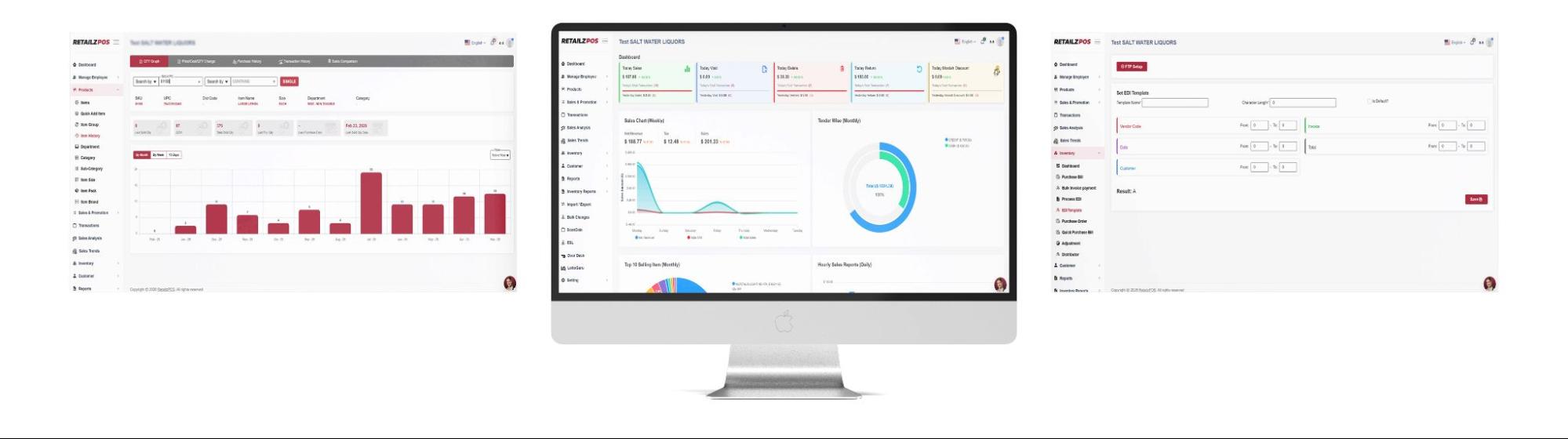
Liquor store POS systems dashboard with inventory management and sales tracking

There has been a significant change in the profitability and rewards available in the liquor business over the last few years. There is no question that, in earlier days, having a cash register and a basic credit card processor was sufficient to run a business successfully. But in 2026, the reality is that the liquor store industry operates on low returns, in complex regulatory environments, and with a consumer base that expects an “Amazon-level” advantage. To compete successfully in the world of liquor retailing, it’s no longer enough just to have a point-of-sale system; you need an all-in-one system to grow both sales and margin.

This guide covers everything you need to know to select a liquor store POS system that secures your license, optimizes your inventory, and generates revenue.

Running a successful liquor store requires more than just processing sales. A modern liquor store POS solution helps retailers manage inventory, verify customer age, streamline payments, and stay compliant with local alcohol regulations. The best liquor POS system combines advanced inventory controls, fast checkout functionality, and integrated reporting to help liquor store owners maximize profitability.

Whether you operate a single location or multiple stores, choosing the right liquor store POS software can improve operational efficiency and provide better customer experiences.

Key takeaways

  • Track Every Drop: Your system should automatically know that selling one bottle of beer reduces your “6-pack” and “case” inventory. No more manual counting.
  • Stop Fake IDs: Use 2D scanners that catch advanced fakes and expired licenses instantly. This protects your liquor license and keeps you legal.
  • Get Paid by Brands: Use “ScanData” to automatically share sales info with big brands. In return, they send you rebate checks that go straight into your pocket.
  • Save on Credit Card Fees: Use “Dual Pricing” to show a cash price and a card price. This helps you get back the 3% or 4% you usually lose to bank fees.
  • Sell Online & In-Store: Your POS should talk to apps like DoorDash or UberEats. If you sell your last bottle in the store, it should disappear from the app immediately, so you don’t have to cancel orders.

Why Liquor Stores Need Specialized POS Systems?

While most liquor store POS software is designed to work for any business, liquor stores are not “any” kind of business. With complex inventory structures and strict laws, standard POS software will only create more work than it saves.

From complex inventory units to strict legal mandates, a standard retail system often creates more work than it saves. Because they manage the same product in three different forms- cases, packs, and single bottles, there is a high chance of increasing manual workload and errors. However, a pos system would require a liquor pos integration to boost your bottom line. Indeed, there are unique liquor POS systems, such as RetailzPOS, designed to address a liquor store’s specific “pain-points.” For example, this POS software simplifies unit conversions. When you sell a single bottle, it automatically adjusts your packs and cases accordingly. Furthermore, this liquor store pos system connects your back office to your front-end sales.

Stay Compliant Automatically—Without the Extra Effort:
In 2026, Compliance is more than just reminding staff to check an ID. It’s a digital-first operation built directly into your POS system. Modern POS systems use 2D barcode scanning to instantly verify IDs, which helps capture advanced fake IDs and expired licenses that the human eye often overlooks. These barcode scanning POS also automate the “nightmare” of regulatory compliance. You no longer needed to manually reconcile sales for state excise taxes or volume limits. The software also generates audit-ready logs and tax-mapped reports in real-time. It automatically applies precise tax rates to beer, wine, and spirits while recording every restricted transaction.

Manage Inventory from Cases to Singles:
One of the biggest reasons liquor stores need a POS system is to manage inventory. Suppose you receive a shipment of 50 cases of XYZ beer and sell some as full cases, some as six-packs, and others as individual cans. An alcohol inventory management POS system like RetailzPOS supports tracking parent-child relationships. Say a consumer purchases a single can; the system automatically updates your inventory by deducting the exact portion from the case. This confirms that your stock levels are accurate across all SKUs without requiring manual counting every day. Under today’s liquor POS standards, failing to track bottle sizes accurately results in hidden inventory loss.

ScanData & Vendor Rebate Programs:
In liquor retail, actual profits come from the backend: manufacturer rebates and incentive programs offered by major alcohol distributors. ScanData programs let retailers securely share sales data with suppliers in exchange for per-unit discounts. Liquor store compliance software handles this automatically. Instead of manually pulling reports or managing spreadsheets, the system collects the data and sends it to the vendor. This feature makes it easier for stores to run promotions like buy two, save $1, without cutting into your margins because the vendor pays you back.

Market Insight: The liquor POS software market is hitting its stride. Valued at $3.2 billion in 2024, it’s projected to reach $5.4 billion by 2030—a steady 9.1% annual growth rate according to Strategic Market Research.

Unlike traditional retail businesses, liquor stores face unique challenges including age verification, alcohol compliance, inventory tracking, and distributor management. A dedicated POS for liquor stores is designed to address these challenges with industry-specific features.

Retailers can benefit from:

  • Real-time inventory tracking
  • Age verification tools
  • Integrated payment processing
  • Vendor and distributor management
  • Compliance reporting
  • Customer loyalty programs

Alcohol Inventory Management Software

Effective inventory control is critical for liquor retailers. RetailzPOS includes powerful alcohol inventory management software that tracks every bottle, case, and SKU in real time.

With our advanced inventory tools, store owners can:

  • Monitor stock levels automatically
  • Track case-breaking inventory
  • Receive low-stock alerts
  • Manage multiple store locations
  • Generate inventory valuation reports

This comprehensive liquor store inventory system helps reduce shrinkage and improve profitability.


Liquor Store Payment Processing

Fast and secure transactions are essential for customer satisfaction. RetailzPOS offers integrated liquor store payment processing that supports:

  • Credit and debit cards
  • Contactless payments
  • Mobile wallets
  • Cash discount programs
  • Dual pricing solutions

By combining payment acceptance with inventory and reporting tools, our liquor store POS software provides an all-in-one solution for modern liquor retailers.


Liquor Store Compliance Software

Alcohol retailers must comply with strict state and local regulations. RetailzPOS includes built-in liquor store compliance software features that help businesses stay compliant and avoid costly penalties.

Compliance features include:

  • Sales reporting
  • Audit trails
  • Employee permissions
  • Age-restricted product controls
  • Transaction history tracking

Liquor Store Age Verification System

Preventing underage alcohol sales is a top priority. RetailzPOS includes a reliable liquor store age verification system that helps cashiers quickly verify customer eligibility.

Benefits include:

  • ID scanning support
  • Automatic age calculation
  • Compliance alerts
  • Reduced human error
  • Faster checkout experiences

The integrated liquor store age verification system helps protect your business while ensuring compliance with alcohol sales regulations.

Must-Have Features for Liquor POS System 2026

One Inventory for Every Way You Sell:
When a consumer purchases the last bottle of a rare bourbon in-store, your website and third-party apps (Drizly, Uber Eats, DoorDash) must be able to handle the change in real time. By utilising cloud-based POS as the unified data source, you eliminate inventory falls that lead to disappointed customers and manual order cancellations. Your team can sell more through digital channels without increasing manual workload.

Never Run Out with Automatic Restocking:
Your inventory should move as fast as your customers. Modern Point-of-Sale (POS) ecosystems now utilized advanced AI to address the critical gap between backend stock and real-time market demand. As an omnipresent analytical layer, the liquor store POS system identifies trends by analyzing seasonal and small-scale dynamics. This allows you to predict shortages with clarity rather than simply reacting to them.
Once it reaches a set limit, the system voluntarily generates a complete purchase order, ready for instant verification and one-click transmission to your distributor. Such flawless integration gives excellent product availability, reduces idle capital, and ultimately boosts your cash flow.

Reduce Processing Fees with Dual Pricing:
Credit card processing fees are often the biggest monthly headaches for liquor store owners. Today’s liquor store POS software includes dual pricing features that clearly show cash and card prices, keeping things transparent for customers while helping you retain more of every sale. And because our payments are fully integrated, your terminal and POS stay in perfect sync. We will no longer have to deal with manual-entry errors in which a $100 bottle of bourbon rings up as $10. It’s about making sure you get paid exactly what you’re owed, every single time.

Total Security and Staff Access Management:
Who handles what at the register? A good liquor store pos lets owners decide exactly which staff can open tills without a sale, process returns, or give price cuts. When someone hits void or refund, modern setups integrate directly with camera feeds. That exact second gets marked automatically in the video stream. Reviewing events is faster when the moment stands out clearly. Oversight improves. The risk of theft decreases when actions are linked directly to visuals.

How to Choose the Right Liquor Store POS Software?
With so many options available in the market, the selection process becomes challenging. To make the right decision for your particular business, focus on these three pillars:
Clear Pricing for Hardware, Software, and Processing Fees:
Look beyond “free” hardware offers and focus on long-term value. These companies often offset hardware costs through higher payment processing rates over time. When calculating the costs, look at the total cost of ownership:

  • Consider hardware costs. Is it proprietary, or can you use standard tablets and printers?
  • Software costs. What is the monthly subscription fee, and does it include all features, or are there “add-ons”?
  • Don’t forget processing costs. Are you forced to use their processor, or can you shop around for the best rates?

Built to Scale from Your First Shop to Your Fiftieth:
You should pick a point-of-sale system that can manage ten stores in the future, even if you only have one store now. Having a “Multi-Store Management” dashboard is necessary for expansion. It should be possible to transfer inventory from a store with low sales to one with high sales, and to change the price of a particular product across all locations. The industry norm is cloud-based systems. Whether you are physically present at the store or not, you can view sales data on your smartphone.

Expert Support and Training to Keep Your Business Running:
The worst time for your POS to crash is at 6:00 PM on Friday. For what reason? Because of the high volume, it’s probably during peak hours. Take into account the following before signing a contract:

  • Do they provide round-the-clock, US-based support?
  • Does the POS screen include a “Live Chat” feature?
  • How long does it typically take to get support?

An easy-to-use system is also essential. You cannot afford to train every new hire for 20 hours, given how high retail turnover is. Floor errors and training time can be decreased with an easy-to-use point-of-sale system such as RetailzPOS.

TL;DR: Must-Have Liquor Store Features

  • Cash Discounting: Built-in rules to protect your margins.
  • ID Scan Prompts: Mandatory age verification to eliminate legal risk.
  • Audit Logs: Real-time inventory tracking to stop shrinkage.
  • No Processor Lock-in: The freedom to choose your own payment provider.
  • Custom Permissions: Secure access levels for different staff roles.
  • Hardware Flexible: Use your existing equipment to save costs.
  • Offline Mode: Keep selling even if your internet goes down.
  • Multi-Store Ready: Manage all locations from one central dashboard.
  • Shift Summaries: Fast, granular reporting for easy reconciliation.
  • Accounting Sync: One-click integration with QuickBooks and ScanData.

Final Thoughts

The competition in the liquor industry is fiercer than ever. You are facing off against big-box algorithms and delivery giants with limitless reach, not just the store down the street. You must use cutting-edge technology that makes your operations more intelligent, efficient, and compliant with regulations if you want to stay in the market. Your company’s core is a smart liquor store point-of-sale system. You are creating a roadmap for your store by automating compliance, managing inventory, and embracing omnichannel sales.

From managing multiple stores to providing regulatory protections, RetailzPOS handles the heavy lifting with complete transparency and no hidden costs. It’s the tech you need to get back to what matters: your customers and your growth.

RetailzPOS is the best liquor store POS solution for liquor retailers looking to streamline operations, improve inventory accuracy, and increase profits. This liquor store POS platform combines inventory management, compliance tools, and payment processing into one powerful system.

FAQs:

1. Do I really need a liquor-specific POS, or can I use a regular retail system?

While a standard retail system handles basic transactions, it often falls short in the highly regulated world of alcohol. A liquor store pos offers case break capabilities, age-verification prompts, mix-and-match pricing, and wholesale reports.

2. What happens to my sales if the internet goes out?

Our RetailzPOS is cloud-based for easy management, but we know outages happen. Our system includes an offline mode that lets you continue ringing up sales locally. Once your connection is restored, all data automatically syncs to the cloud.

3. How does RetailzPOS handle “Case Breaks” and inventory?

RetailzPOS has an Automatic Inventory Cascading feature. When a single bottle is sold, the system immediately updates the stock levels for all units and “breaks” a case in the digital inventory.

4. Can I automate my ordering with distributors?

Yes. RetailzPOS supports EDI Invoicing. This allows you to receive invoices from major distributors electronically. You can review and “accept” the electronic invoice to update your stock counts and cost data.

Liquor Store POS Systems – All Features You Could (AND COULD NOT) Think of!

liquor store pos system

Liquor Store POS Systems – All Features You Could (AND COULD NOT) Think of!

When you walk into a liquor store pos, what do you see? What do you hear? To answer these questions, many liquor stores have installed point-of-sale or “POS” systems—computers that sit behind the register.

These POS systems have all your personal computer features and are always scanning for card swipes and reprinting receipts. With such a wide variety of features available, there is bound to be something that will interest anyone in the market for a new Retail POS system on their business premises.

In this article, we will give an overview of the various features of some of these popular POS systems and how they could benefit your business operation.

What do Liquor Store POS systems do?

A POS (point-of-sale) system is a device that keeps track of the wine, spirits, and beer items a liquor store is selling and manages the transactions. The system keeps track of all the wine, beer, and spirits products a store has available and how much they have left. It also keeps track of the prices customers pay for each item. When customers order drinks, they get a receipt with their purchase information. If someone buys multiple items during one transaction, they get multiple receipts.

Several things happen automatically with systems:

  • Billing customers.
  • Keeping receipts for tax purposes.
  • Storing information on who bought what and when they did it.

This POS system can be designed to do much more than that: it can be fully customized by businesses to fit their specific needs. It doesn’t necessarily have to just manage wine, though — many stores also use it for other products.

Features of Liquor store POS systems

Liquor store brick-and-mortar POS systems have been evolving for over 20 years. Most retailers in the U.S. are adopting new technology due to retailers competing on social media and online rankings.

Boost Sales with Product Recommendations:
POS systems enable liquor stores to add almost any feature they can think of. You can become an expert by integrating your database of notes from liquor manufacturers, wineries, and breweries (this advanced feature requires your setup and configuration). The liquor POS system can pull up the necessary information when a customer asks for a recommendation. With POS systems, you can position yourself as the expert and increase sales.

Customer Facing Displays:
Your customers can see the details of their transactions as well as promotional videos or graphics highlighting your current sales or seasonal products. A customer may decide to use one of your featured products.

Digital Touchscreen:
As off-premises retail continues to grow, touchscreen technology has provided a new way of interacting with consumers. Rather than turning your back on customers, you can now be working around them without losing any customer interaction.

Integrated Sales Floor Management:
A major advantage that starting off-premise operations has is being able to focus more solely on sales floor management for better customer service and increased profit margins.
Real-time inventory management:

Many brick-and-mortar liquor stores do not know the inventory count in the store when they are open, which leads retailers to pay a lot more on inventory than necessary because it is very costly to order more of an item. This is the case for many liquor stores that still operate cash registers and have no way of tracking inventory in real-time.

Digital Signage:
The ability to attach digital signage allows liquor stores to display important information like happy hour information in digital signs throughout their store. Most importantly, this allows retailers to change the displays at will, something that not every retailer has been able to do due to space or cost restraints.

POS designed for off-premise:
An extremely important distinction between traditional Point of Sale Software and newer systems is that they have to be designed specifically for the liquor industry. Very few retailers have taken advantage of POS that is designed specifically for the liquor industry.

Reliable ID Verification
As technology advances, it becomes more difficult for liquor store pos owners and employees to tell the difference between a real ID and a fake ID. Before a sale can begin, the POS system for liquor stores requires all driver’s licenses or state ID cards to be scanned. The sale will be canceled if the system discovers that the potential customer is underage or that the ID card is not genuine.

Gift and Loyalty Programs
Liquor and wine make excellent gifts. It may be difficult, however, to always get it right when it comes to what friends and family members prefer. Your liquor store can help your customers give the perfect gift without having to guess what the recipient likes by providing a gift solution, such as gift cards. They make excellent gifts and can be used at the recipient’s leisure.

Payment Processing Alternatives
Customers’ payment options within your locations are expanding as retail and liquor store technology evolves. New payment methods are emerging in addition to traditional payment methods, such as cash and credit or debit cards.

A Strong Back Office Suite
Your back-office software must be used for all aspects of your liquor store operation. From employee scheduling to inventory management and vendor management, you need a back-office solution that is powerful enough to run all aspects of your business.

Future-Proof integrations
It is impossible to anticipate what the future will carry. However, as you plan and prepare, keep your liquor store tech in mind and what you will require to succeed. Retail Ecommerce is the future, and it would be prudent to invest in technology that not only assists with your liquor store’s in-store functions but also easily and efficiently integrates with one’s liquor store POS system to close both online and in-store sales.

Bottom line

Business owners can benefit from liquor store POS systems in a variety of ways. Liquor store POS systems make it easier for business owners to manage their stores by automating tasks and tracking inventory. Furthermore, liquor store POS systems can help boost sales by making it easier for customers to buy items.

5 Best Liquor Store POS Systems in 2022

Best-Liquor-Store-POS-Systems-in-2022_Comp

5 Best Liquor Store POS Systems in 2022

You’re in for a dizzying array of choices when it comes to buying liquor POS systems. But what will be the best brands in 2022? We are so glad you asked! We’ve compiled our top picks for 2022, and we’re going to tell you all about them.

The liquor store POS system is the bedrock of any convenience store pos. If you want to sell liquor at your store, you need a good liquor POS system that can process credit cards and save data to make your life easier. Superior liquor stores are always looking for new ways to drum up revenue. One way is by instituting a point-of-sale system that helps out customers by handling the most tedious and time-consuming tasks. A great way to entice new customers is by giving them a reason to spend more money, and one strategy is creating a retail POS system that can help sell drinks more efficiently.

The article will tell you which are the best liquor store POS systems in 2022 and what to look for when you’re buying one.

Why choose the best POS system?

One of the most important business decisions that new convenience stores that want to sell alcohol must make is what type of point-of-sale (POS) software they should use. Liquor POS systems assist liquor store owners in selling more liquor both in-store and online, as well as providing important business management features. A good liquor store POS system will be simple to use, offer curbside and delivery options, inventory management features, and more.

Age verification for alcohol purchases is another industry-specific feature of liquor store POS systems. A liquor POS system can also allow you to set multiple sales tax rates for different types of alcohol and provide robust reporting features for compliance.

5 best POS systems for liquor stores

KORONA

KORONA uses existing hardware providing robust inventory tracking with vendor management, Case promotions, and case-break tools. We get several options for a payment processor. Though Inventory management tools are not available in the basic plan and native online store functionality is absent, KORONA still tops our list.

KORONA is extremely simple to set up. You sign up for a KORONA account and immediately gain access to a KORONA management dashboard. You can use a free demo version of the app to test all of the features and see if KORONA is a good fit for your liquor store. Users can also rely on KORONA to assist them in locating the best payment processing rates.

POS Nation

POS Nation can integrate with a variety of payment processors. Age verification is also easy here. We also find cash discount options and case-break inventory tracking. Except for the fact that there are limited e-commerce capabilities, the need to buy extra hardware and payment processing, and customer service restrictions in the subscription tiers, POS Nation still tops in the 5 best POS systems.

Many liquor store support tools, such as age verification prompts and barcode-scanned inventory counts, are included in POS Nation. POS Nation, like KORONA, integrates with several payment processors. Monthly users must use Worldpay. Other POS Nation users, on the other hand, have the option of using Worldpay, First American, Evo, Heartland, Priority I.S., or North American Bancard.

Harbortouch

Harbortouch comes with included hardware at affordable prices. It also includes an age verification system. Though it’s one of the best retail POS systems, we shouldn’t forget it is locked into Shift4 Payments and lacks liquor industry e-commerce integrations. A subscription is a long-term contract. It also lacks payroll integrations.

Harbortouch, like the majority of the other systems on this list, includes age verification prompts and comprehensive inventory tools with vendor management. Harbortouch also has slightly more robust payroll reporting than KORONA and POS Nation; users of Harbortouch can track overtime hours and export time clock records to an external payroll system.

Lightspeed Retail

Lightspeed Retail works well on iPads. It’s also easy to self-install. The system has comprehensive inventory tools. The demerits are that it requires a strong internet connection. Subscription prices are at the higher end. Hardware is also priced on a customized basis.

Lightspeed Retail is the sleek, modern brother or sister to the older desktop computer POS systems on this list. The iPad-based point-of-sale system is mobile and adaptable. You can use the iPad POS in your shop to count inventory or show customers product images. The low-profile terminals make it simple for your employees to interact with customers, and the iPad interface is familiar to anyone who has used a smartphone.

Retailz POS

RetailzPOS has customizable touchscreens, security integration with remote eyes, age verification, and case-break inventory and pricing tools. But, on-site help for the system costs more. The system doesn’t have any email marketing tools and not many liquor industry-specific integrations.

It includes all of the features required by a liquor store, such as inventory tracking with vendor management and low stock alerts, age verification, and case-break pricing. RetailzPOS, in addition to these features, runs on industry-grade hardware with customer-facing displays and countersunk pos barcode scanners to support high-volume store operations.

Bottom line

Choosing a liquor store POS system entails more than just having the tools to ring in sales at the lowest possible cost. Liquor store owners require inventory control and sales management tools that are unique to their industry. To successfully meet customer demands, liquor store owners must outsource their POS applications and implement a system capable of accurately managing inventory, sales, labor, and management while also connecting to payment processing systems. We hope this article has helped you decide on which is the best liquor store POS system.

5 Liquor POS System Features Your Store Must Have

liquor-pos-system-features_comp

5 Liquor POS System Features Your Store Must Have

Ecommerce has had its fair share of growing pains as it transitions into a mainstream retail destination. Many brick-and-mortar retailers were caught off guard by the monumental shift in shoppers’ purchase paths, and features that were formerly regarded as standard in most grocery stores’ POS are barely being utilized today.

Several brick-and-mortar retailers have shuttered their doors in the past few years or found themselves forced to sell to stay afloat. This is due largely to competition from online retailers such as Amazon and Walmart. Consumers use their devices for nearly every facet of their shopping experience; bargain hunting, price comparison, and ultimately fulfillment of purchases.

Coming to the liquor industry, it’s no different. Online sales have been soaring as more consumers shop from the comfort of their homes. Retail experts predict that online sales for liquor pos systems will be at about $21 billion by the end of 2023. That’s roughly an additional 8 percent growth year over year.

But for all of its success, eCommerce has its drawbacks. First and foremost is security, followed closely by price transparency and delivery. Ecommerce retailers have little control over these variables (outside their websites) as they are out of their hands.

Hence, every liquor pos system owner wants a system that is easy to use, customer-friendly, and profitable.

A dependable Retail POS System simplifies business operations by allowing you to manage your sales, inventory, and employees effectively. Most importantly, it can assist you in providing a flawless customer experience that will keep them wanting to return. While POS systems benefit all businesses, they are especially beneficial to bars due to their fast-paced environment! A bar Point-of-Sale system is a computerized cash register that allows bar managers to track and control inventory and generate sales analysis reports. A POS system will make more efficient pricing decisions and reduce the risk of costly errors.

That’s why, in today’s blog, we’ll go over 5 essential features of a bar POS system and why they’re so important in this industry.

Liquor & Bar Inventory Management

Most high-quality POS systems include real-time inventory control software that shows you how much inventory you have on hand at any given time. These programs and APIs allow you to track your liquor inventory, suppliers, and prices independently. This makes it extremely simple to determine what to reorder and when. You won’t have to spend hours updating a spreadsheet manually. Simply check your system to see if it has all the required inventory management features.

Payment Preauthorization

Payment pre-authorization lets bartenders securely swipe a customer’s credit/debit card and save the details as their bar tab. The bartender can use this to determine whether the card is genuine and has enough funds to pay the bill. This is critical because credit card fraud is on the rise.

You can avoid the following problems by using a bar POS system that uses payment processing that allows pre-authorization of credit and debit cards:

  • Fake identification cards
  • Cards taken
  • Unpaid cheques

Order Customization

When you select a fully customizable and functional system, you will have a unique product that is crafted to your needs and completely original! The possibilities are endless. Your guests will love their unique experience. The bar POS system will be able to process orders quickly and efficiently. This means you won’t have any delay while they wait. As a result, your guests will call back time and time again! No bar is the same, so why should your POS system be? Don’t settle for anything less when you can create the perfect POS system that is uniquely yours.

Easy Menu Management

Selecting a POS system that allows you to effortlessly make changes to your menu in real-time from any location is critical. You’ll need a system that can handle changes to your happy hour menu, seasonal menus, and regular inventory changes from week to week or day to day. We recommend paying attention to the details when looking for the best Retail POS system in Atlanta. Avoid POS systems that take more than 5 minutes to update menu items or require a reboot. Modern POS systems perform actions instantly and have interfaces that simplify changes.

Cloud Technology

You need a solution that can be accessed from any location at any time in our fast-paced world. Your POS system needs to be scalable as your company expands. If you’re searching for this, a cloud-based POS system is what you require. The advantages of cloud-based POS systems are as follows:

  • inventory updated in real-time
  • Data can be retrieved from any device with ease.
  • Employees can easily access and amend their schedules.
  • By providing a range of payment methods, you can enhance client satisfaction.

Best Bar POS system providers

No merchant should let out time and energy on laborious activities that may be completed quickly on a POS system because managing a bar is not an easy undertaking. A solid POS system can work wonders for you to enhance customer satisfaction and simplify business management.

RetailzPOS provides the best POS systems and services for businesses like yours. Get in touch with us!