Introduction
Convenience stores run on speed. Customers expect to grab their items and check out in seconds. Every delay, error, or manual process costs you money and customer loyalty. Each day, managing thousands of fast-selling products, age-restricted items, and low-profit margins requires more than a generic point-of-sale system for convenience stores. Many owners buy a cheap convenience store pos system and regret it months later. POS Software that fails to manage instant inventory updates and regulatory guidelines, or fuel pumps can result in lost sales and constant stress.
Choosing the right POS system for c-store operations in 2026 can secure your earnings and enhance the checkout journey. This blog will guide you through the right approach to choosing a platform that actually helps you grow your business.
What is a Convenience Store POS System?
A convenience store POS system combines hardware and software to improve your checkout experience and routine workflow. It rings up sales, manages stock levels, and reports in one place. The POS software is built for how convenience stores actually work- lots of SKUs, instant transactions, and stock replenishment. It also handles things like age verification and short-shelf-life products that general retail POS systems often lack.
Why Convenience Stores Need a Specialized POS System
Convenience stores aren’t just small retail stores; they run under a unique set of pressures that most general-purpose POS systems weren’t created to handle:
- High SKU and fast sales: from snacks to beverages to tobacco products, inventory moves quickly and requires frequent tracking.
- Age-limited product sales: tobacco, vape, and alcoholic beverages require built-in compliance checks, rather than relying on manual decisions at checkout.
- Fuel and in-person sales under one roof-for stores with pumps, syncing fuel transactions with physical store sales is important for precise reporting.
- Small profit margins- every minute of break or checkout delay directly impacts revenue.
A POS system for c-store environments needs to be built around these realities from the ground up, with the right tools already in place for how convenience stores actually operate. Moreover, convenience stores often deal with unpredictable foot traffic. A peaceful mid-morning can quickly turn into a lunch rush or an after-work rush. The POS system should handle sudden volume spikes without slowing transactions or causing register issues. Staff rotation can also be high, so the system should be easy to learn. New hires should be able to use the pos system confidently within their first shift.
A Fast-Growing Market
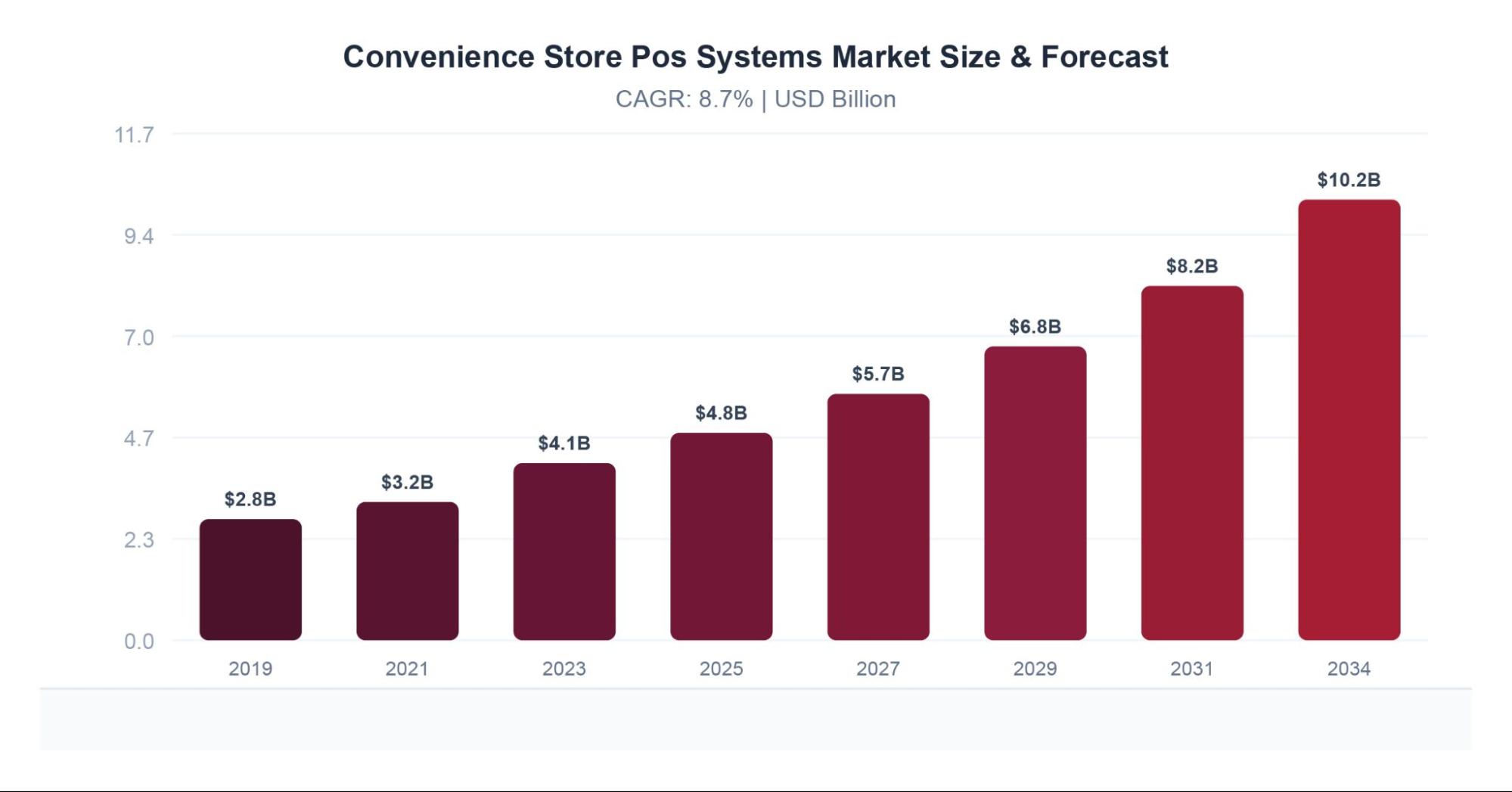
The push toward smarter, more connected POS (point-of-sale) systems isn’t just a convenience store trend – it’s a global shift. Industry estimates put the convenience store POS systems market at roughly $4.8 billion in 2025, with projections showing it could more than double to around $10.2 billion by 2034, growing at nearly 9% a year over that stretch. That kind of sustained growth points to one thing: retailers are actively moving away from outdated, disconnected systems and investing in cloud-based, all-in-one platforms that handle payments, inventory, and compliance together. (Data referenced from Dataintelo.)
Must-Have Features in a Convenience Store POS System (2026)
Convenience Store Inventory Management Software
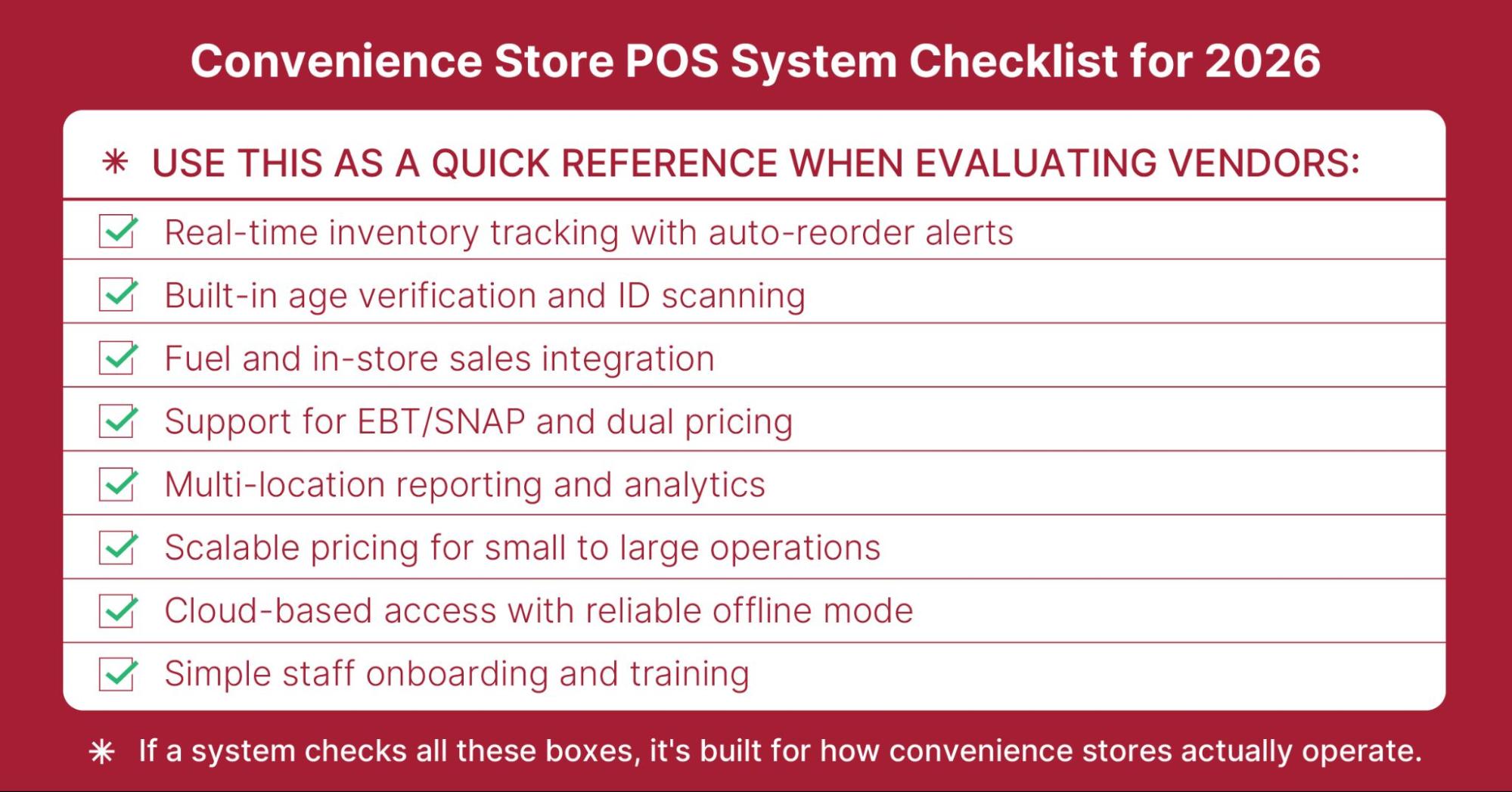
Convenience stores live and die by their inventory. Between fresh food going bad and popular drinks flying off the shelves, staying on top of your stock is a constant battle. That’s where dedicated convenience store inventory management software makes all the difference. Modern systems track stock levels live, signal you when shelves get bare, and place orders automatically before you run out. Plus, tracking expiration dates on perishables helps reduce waste.
- Automatic low-stock alerts and reorder triggers
- Real-time syncing across registers and locations
- Support for perishables with expiration tracking
- Fast SKU lookup for high-turnover categories like snacks, drinks, and tobacco
Without this, owners end up guessing at reorder timing – leading to either stockouts on best-sellers or overstocked shelves tying up cash flow.
Increasing Revenue with Advanced Reporting
Margins in the c-store industry leave no room for blind spots. The best POS for small convenience store setups does far more than process payments. It acts as an analytics hub. High-return convenience store point-of-sale software monitors hourly trends, high-margin categories, and individual employee sales. You can confidently optimize pricing, clear out slow-selling stock, and plan staffing around busy periods.
Age Verification & Compliance Tools
Selling tobacco, vape, or alcohol without proper age checks isn’t just risky; it can cost a store its license. The pos system for convenience stores should include:
- Integrated ID scanning at checkout
- Automatic blocks for underage sales
- Digital logs for compliance audits
This turns age verification from a judgment call into a system-enforced safeguard. Thus protecting both the business and its license to operate.
Fuel Integration:
For stores with pumps, disconnected systems between the forecourt and the register create reporting headaches and reconciliation errors. A modern POS should sync fuel sales directly with in-store transactions, giving owners one unified view of daily revenue instead of two separate reports to cross-check manually.
Payment Flexibility:
Speed means nothing if you can’t accept the way your customer wants to pay. A convenience store POS software should offer customers complete flexibility at checkout. You’ll want a setup that smoothly processes tap-to-pay, mobile wallets, and EBT/SNAP benefits. It also has flexible options like dual pricing or cash discounting to keep credit card fees from cutting your margins. Offering consumers an effortless experience at the registers means fewer dropped sales and quicker lines.
Lottery Management:
Lottery sales bring great foot traffic, but managing tickets manually is quite troublesome. Missing cash, misplaced tickets, and time-consuming cash counts happen all the time. A reliable pos software makes this easier. It records every scratch-off pack from activation to sale. When a customer wins, the register automatically logs the payout against your drawer, helping keep your records accurate. At closing time, matching your sales with state lottery reports takes minutes, not hours. You save time, protect your money, and keep your shifts organized.
Loyalty & Promotions
Convenience store purchases are quick and regular, so loyalty programs need to match that pace: simple point accrual, on-the-spot redemption, and promotions that don’t slow down the checkout process.
Bulletproof Security & Fraud Protection
Your POS should work as hard to protect your business as it does to process sales. Choose a c-store pos that utilizes enhanced encryption for data protection, requires secure login with user authentication, and supports role-based permissions so staff see only what they need. Use a solution that follows payment security standards to keep transactions safe and meet card-brand requirements. The benefits are clear: customer data remains protected, your team gets reliable system access, and fraud prevention tools flag suspicious transactions before they cost you money.
Third-Party Delivery Integration
Convenience stores today can’t ignore the delivery boom. Customers expect to order from DoorDash, Uber Eats, and similar platforms just as easily as they’d walk in your door.
An integrated convenience store pos makes this easy by pulling online orders directly to your main screen. Your staff can manage delivery and walk-in sales from one place. Moreover, your inventory syncs automatically across every channel. When an item sells out in-store, it is removed from your delivery listings too, which avoids awkward cancellations and disappointed customers. And as each transaction is recorded in one single platform, tracking performance becomes simple instead of confusing.
What to Look for in the Best POS for Small Convenience Store Operations
When evaluating the best POS for small convenience store needs, focus on:
- Scalability: Start with core features and add modules (loyalty, EDI, fuel integration) as you grow, rather than paying for enterprise tools you don’t need yet
- Ease of use: C-stores often have high staff turnover, so a system that’s intuitive to learn in a single shift saves real time and money
- Affordable hardware bundles: Look for providers offering scaled-down hardware packages instead of forcing a full enterprise setup
The right system should feel proportional to your store’s size today, while still being ready to grow with you.
Cloud-Based vs. Traditional POS: Which Fits a C-Store Better?
Most owners in 2026 are choosing a cloud-based convenience store pos system over legacy, on-premise systems – and for good reason:’
- Remote access to sales data and inventory from anywhere
- Automatic software updates without needing an IT visit
- Multi-location visibility for owners managing more than one store
That said, uptime matters. A good cloud POS should still include offline mode functionality, so a spotty internet connection doesn’t mean your registers go down during peak hours.
Traditional, on-premise systems still exist, and some owners prefer them for perceived control over their data. But they typically come with higher upfront hardware costs, slower feature updates, and little to no remote visibility; a real limitation for anyone managing more than one location or wanting to check sales from home. For most convenience stores entering 2026, the flexibility of cloud-based convenience store point-of-sale software outweighs the trade-offs.
How RetailzPOS Supports Convenience Stores
RetailzPOS is engineered specifically around the needs outlined above, not adapted from a generic retail template. The pos software combines actual-time stock management and integrated age-check for restricted items, EDI invoicing, and dual pricing support into a unified system. Thus, store owners can manage their day-to-day operations efficiently without switching between multiple third-party tools.
RetailzPOS scales with your business, from a lean setup for a small convenience store to a full multi-location dashboard with consolidated reporting. Explore RetailzPOS for convenience stores or book a demo to see it in action.
Conclusion
Choosing the right convenience store POS system in 2026 comes down to matching your system to how your store actually operates. Quick checkout, high SKU revenue, industry regulations, and (for many) fuel sales. The features outlined in this post are foundational for staying competitive and adaptable this year. Do your research and know your requirements before finalizing a pos system for a convenience store to avoid any costly mistakes.
FAQ
What features should a convenience store POS have?
At minimum, look for real-time inventory management, age verification tools, flexible payment support (including EBT/SNAP), and solid reporting and analytics. If your store has pumps, fuel integration should be high on your list too.
How much does a convenience store POS system cost?
Pricing varies based on hardware, number of registers, and the features you need. Most providers offer scaled pricing, so small stores aren’t stuck paying for enterprise-level features they’ll never use.
Can I switch to a new POS system without interrupting my current operations?
Most modern POS providers offer migration support, including data transfer from your existing system and on-site or remote setup assistance. A well-planned switch can often be done during off-peak hours or overnight, so your store doesn’t lose a single day of sales.
What is the best POS for a small convenience store?
The best POS is one that handles everyday needs like inventory and regulatory requirements without costing too much. It should also be flexible enough to grow with your store, so you don’t have to replace it as your business expands.