Looking for the best retail business growth tips 2026? In today’s competitive market, retailers must adapt fast to increase sales, improve customer experience, and stay ahead of the competition.
Retail in 2026 has moved past the experimental phase. We’ve stopped asking if we should use tech and started asking exactly how much it adds to the bottom line. The reality is a bit of a paradox. Your physical storefront is still your strongest asset, but your digital presence is your only front door. Growing your business today means mastering that handoff between the smartphone screen and the store floor.
While e-commerce remains strong, a recent study by Shopify confirms that 82% of consumers still crave the tactile experience of physical stores. It’s to achieve Unified Commerce: a state where your inventory, staff, and customer data move as one.
If you are searching for tips to grow your retail business, you likely already know the market is volatile. Consumers are trading status for savings, yet they demand more personalization than ever. To win, you must stop ranking for generic keywords and start ranking for availability, proximity, and trust. In this guide, we bypass the fluff and dive into the operational shifts that will actually move the needle for your store this year.
Key Takeaways: Retail Growth at a Glance
If you only have a minute, here are the essential retail store success strategies for 2026:
Reduce Friction: 73% of shoppers will abandon a purchase if the checkout line is over five minutes. Transition to mobile or “Scan-and-Go” options.
Data Over Sixth-Sense: Retailers using advanced analytics are 2.6x more likely to hit growth targets. Guessing won’t work, focus on tracking.
Integrated Inventory: Ensure your physical stock is synced with Google “Near Me” results. If they can’t see it online, they won’t visit in person.
Invest in “Smart” Hardware: Moving to an all-in-one system like RetailzPOS saves hours in manual labor and protects margins through dual-pricing models.
Avoid “Coupon Spirals”: Generic discounts train customers to wait for sales. Shift to Member-Only Pricing to protect your brand’s perceived value and capture vital customer data.
Focus on Customer Experience
In 2026, “customer service” is no longer about a friendly greeting; it’s about Zero-Click Convenience. If a customer has to ask a staff member if something is in stock, you’ve already lost the battle for their time.
Personalized Service via Clienteling: Are Your Staff Clerks or Consultants?
Let’s be honest: in 2026, if a customer just wanted to grab an item and leave, they’d order it from their phone. When they walk through your doors, they are looking for something an algorithm can’t provide—human expertise.
The most effective retail business growth tips today involve turning your staff into “Consultants” rather than just shelf-stockers. Think about it: How much more could you sell if your team knew a shopper’s online “wishlist” the moment they stepped inside?
This is the power of clienteling. By using 360-degree customer profiles, your team can offer customer retention strategies that feel predictive, not pushy.
Ask yourself: Is your team equipped to answer these questions mid-conversation?
- “I saw you were looking at this blazer in navy online—would you like to try it on in the emerald green we just got in?”
- “Since you bought that organic skincare set last month, are you ready for the refill, or did you want to try the new night serum?”
In 2026, 40% of a brand’s perceived value comes from non-price factors. We aren’t just talking about a friendly smile; we are talking about expert product knowledge and a proactive attitude.
Why this matters for your bottom line:
- It builds trust: High-level expertise justifies a higher price point.
- It increases Basket Size: A consultant knows how to suggest the perfect accessory that the customer didn’t even know they needed.
- It kills the competition: A website can’t tell a customer why a specific fabric suits their lifestyle, but your trained staff can.
If your staff is still just “checking the back” for sizes, you are missing out on the biggest growth opportunity in modern retail. Are you ready to stop selling products and start selling expertise?
The Death of the Queue: Is Your Checkout Killing Your Sales?
Let’s talk about the “Store Abandonment” epidemic. We’ve all seen it: a customer walks in, finds an item they love, looks at the checkout line, and walks right back out. They’d rather pay more online than stand behind three people.
Research shows that 73% of shoppers will bail if the wait exceeds five minutes. If you aren’t offering Scan-and-Go or self-fulfillment options, you are essentially handing your customers to your competitors.
Here is the 2026 reality check: To truly understand how to increase retail sales, you have to start treating checkout as a moment not a station.
- Why make them wait? By letting customers scan items with their own phones, you turn their device into a personal cash register.
- Why waste floor space? Large, bulky counters are “dead space.” Every square foot used for a traditional line is a square foot that isn’t selling a product.
- Why limit the sale? When checkout is frictionless, the “pain of paying” is reduced. This leads to higher impulse buys and a better retail store success strategy.
Ask yourself: Is your checkout a finish line or a hurdle? If it’s a hurdle, your customers are going to stop jumping. By implementing “Self-Fulfillment” hubs (where customers can pick up online orders in seconds), you bridge the gap between digital speed and physical touch.
The Strong Point: In 2026, speed isn’t a luxury; it’s a loyalty requirement. If you can save a customer ten minutes, they will give you ten years of loyalty.
The Silent Partner: Why Your POS is Your Most Reliable Team Member
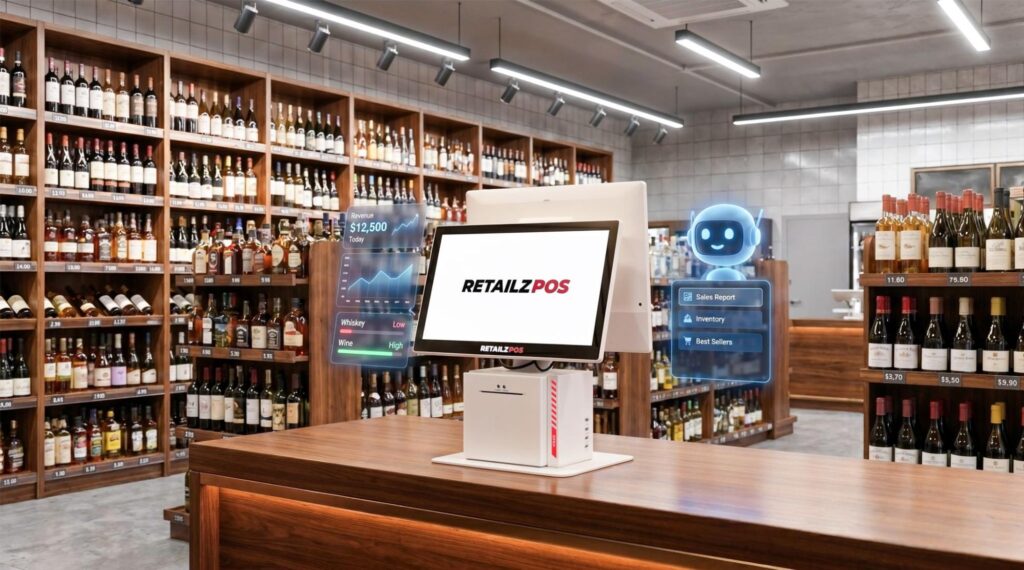
In 2026, your Point of Sale (POS) system can no longer be just a glorified calculator. If your tech only handles transactions, it’s actually costing you money. To truly scale, you need an intelligence engine that bridges the gap between your physical shelves and the digital world. This is where opting for a specialized solution like RetailzPOS changes the game.
Think of RetailzPOS as the central nervous system of your business. It doesn’t just record sales; it actively drives retail business growth tips by managing these four critical pillars:
1. Unified Inventory Schema: Be Found, Not Just Seen
Have you ever searched for a product “near me” only to find it out of stock when you arrived? That is a growth killer.
- The Feature: RetailzPOS uses a Unified Inventory Schema that automatically syncs your shelf stock with search engines.
- The Impact: When a local customer searches for a specific item, your store shows up with an “Available in Store” badge. This drives high-intent foot traffic—people who are ready to buy right now because they know you have exactly what they need.
2. Dual Pricing for Margin Protection:
In 2026, credit card processing fees can eat up to 4% of your total revenue.
- The Feature: Dual Pricing allows you to display a “Cash Price” and a “Card Price” transparently at the register.
- The Impact: It protects your bottom line by passing on processing costs or incentivizing cash payments. RetailzPOS handles this calculation effortlessly, ensuring you stay compliant while keeping your margins healthy.
3. AI-Generated Demand Forecasting (RetailzRAI)
The biggest waste in retail is “Dead Stock”—products that take up space but never move.
- The Feature: Powered by RetailzRAI, the system analyzes historical sales, local trends, and even seasonal shifts.
- The Impact: It identifies slow-moving items before they become a liability. By knowing exactly what to reorder and what to clear out, you achieve true inventory optimization. This frees up “lazy capital,” allowing you to reinvest in products that actually sell.
4. Granular Sales Analysis: Know Your “Hero” Products
If you don’t know which 20% of your inventory generates 80% of your profit, you are managing by guesswork.
The Feature: Advanced Sales Analysis dashboards break down your performance by hour, category, and even individual employee performance.
The Impact: You can see exactly when to staff up and which upselling techniques are working. It turns “gut feelings” into a data-backed roadmap for how to increase retail sales.
Increase Sales with Smart Marketing
Marketing in 2026 is no longer about “shouting” to the masses. It is about Profit-First Personalization. According to Deloitte’s 2026 Retail Report, 56% of consumers now spend more with brands where they hold a membership.
From “Blanket Discounts” to “Loyalty Firewalls”
The problem with generic coupons is “Price Erosion.” If you offer 20% off to everyone, customers mentally “anchor” your product’s value at that lower price. They will refuse to pay full price later.
To grow in 2026, you must use Loyalty Firewalls. Only offer deep discounts to registered members. This does three things:
1. Protect your Margin: You aren’t giving away money to “one-and-done” shoppers.
2. Captures First-Party Data: You get their email and shopping habits in exchange for the deal.
3. Triggers “Loss Aversion”: When a non-member sees a “Member Price” that is $10 lower, they feel like they are losing money by not joining.
Livestreaming & “Scarcity” Promotions
Livestream commerce is now a standard for local shops. Use in-store “Live” events to showcase new arrivals. Instead of a general sale, use scarcity-based in-store promotions. Offer a “Flash Code” valid only for 60 minutes during the stream. Data from Bloomreach shows that these high-urgency, personalized promotions see conversion rates 3x higher than traditional email blasts.
Optimize Operations
Backend efficiency funds your frontend growth. If your operations leak money, your marketing cannot save you.
Circular Retail & Modern Inventory
Modern inventory management now includes “re-commerce.” Successful retailers often have a section for “pre-loved” items.
This appeals to the 70% of Gen Z shoppers who prioritize sustainability. It ensures no product goes to waste. Use RFID tags to track an item’s entire lifecycle. This transparency builds trust. It turns your inventory into a circular, sustainable asset.
Staff Productivity & AI Collaboration
In 2026, we will focus on “AI-augmented” staff. Stop giving humans “robot work.” Use systems like RetailzPOS to automate manual stock counts and shift scheduling.
This boosts staff productivity by letting them focus on selling. When staff have the right tools, they feel empowered. They provide better service. A happy team is your most effective marketing tool.
Final Words
Growing a retail business is no longer about luck. It is about the relentless pursuit of removing friction. By combining high-tech tools like RetailzPOS with high-touch customer retention strategies, you create a brand that is built to last.
Growth is a result of these proven retail store success strategies. Pick one area—inventory, checkout, or community—and optimize it today. The momentum will follow.
FAQs
How can I improve my customer experience without a huge budget?
Focus on the “Small Wins.” Ensure your store is clean and well-lit. Train your staff to be experts, not just cashiers. A handwritten “thank you” or a personalized product recommendation costs nothing but builds massive loyalty.
Which data metrics are most important for a small retail business?
Prioritize your Conversion Rate and Customer Lifetime Value. If people walk in but don’t buy, your layout or pricing is the issue. If they only buy once, your loyalty strategy needs work.
How do I know if my inventory management needs an upgrade?
If you have “phantom stock” (items the system says exist but aren’t there) or if you are constantly discounting old items, you need an upgrade. A smart system like RetailzPOS prevents these losses.
How can I increase staff productivity without causing burnout?
Automate repetitive tasks. If your staff spends hours on paperwork, they can’t spend time with customers. Give them mobile tools to handle inventory and sales on the floor. This makes their job easier and more engaging.